8% vs 15%
Clicked a traditional result
A traditional result was clicked less often when an AI summary was on the page.
Buyers now meet a company inside an answer from ChatGPT, Gemini, Perplexity, or Google. We make yours a name those systems can read and a person can verify.
Thank you. We have your note and will reply by email.
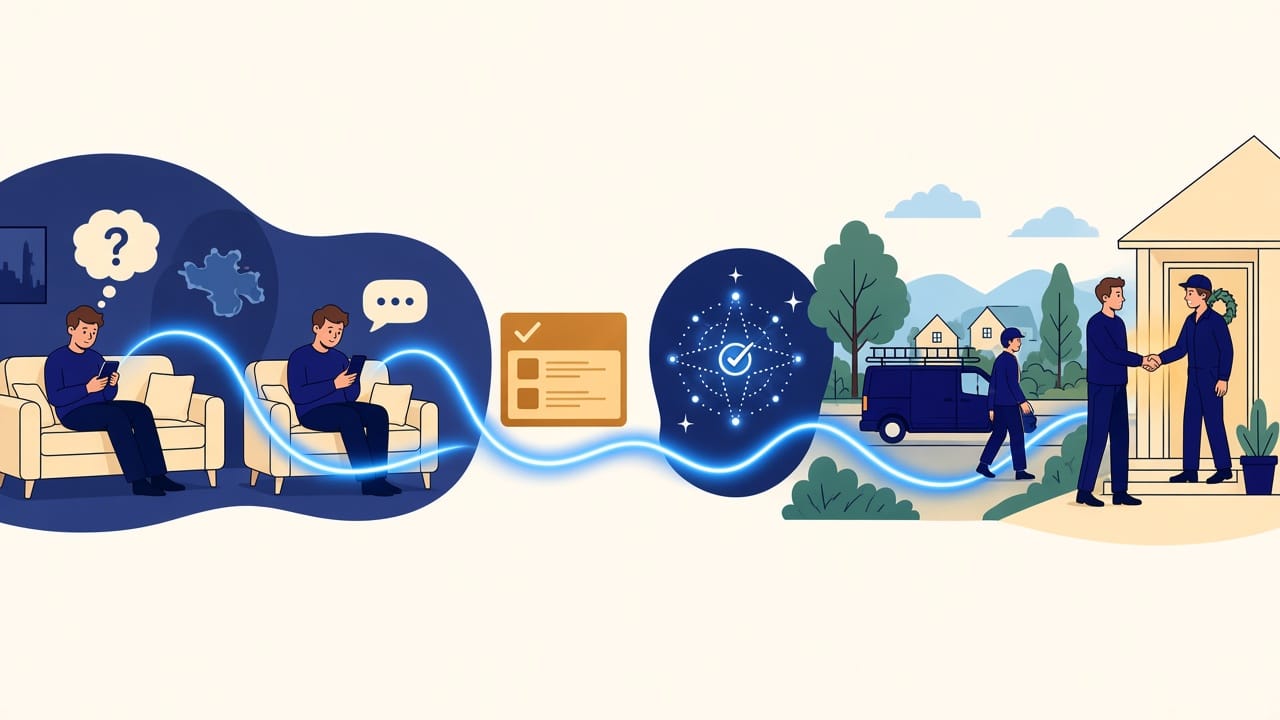
The customer thinks, asks an AI, gets a shortlist, and calls the business it trusts.
Three findings from published research. None of them are our client results.
Clicked a traditional result
A traditional result was clicked less often when an AI summary was on the page.
Visibility in the GEO paper
Citations, quotations, and statistics raised source visibility on the authors’ benchmark.
Clicked a link inside the summary
When an AI summary appeared, a link inside the summary itself was clicked in 1% of visits.
The crawlers you want are allowed in, and the answer is in the HTML rather than trapped in a picture.
The company has one name and one description everywhere, and the schema repeats only what a reader can already see.
A claim is specific enough to check, and a result we cannot show is left off the page.
The first lines are the answer, in text a person or a model can lift without guessing.
The company can be found in search and named inside an answer.
A link back to the page, not only a name dropped in the paragraph.
What the page says can be traced to a source someone else could confirm.
A company that can be read and checked is still in the set when the list gets short.
Local businesses whose customers ask an AI who to choose.
Named when buyers and sellers ask an AI who to hire in your area.
Named when patients ask for a provider near them, with hours and insurance that are correct.
Named when a homeowner asks who to call, with the details that decide the call.
A labeled placement on a Tennessee guide we publish, under that guide’s own sponsor policy.
We also publish our own Tennessee guides: Spring Hill TN Guide and Tennessee Radon Authority. See the network
SEO is the work of making a website easy for a search engine to crawl, index, and rank for a relevant query, without paying for an ad. Google says to apply the same foundational SEO practices to its AI features, because those features use the Search index. A page has to be indexed and eligible to appear with a snippet.
AEO, answer engine optimization, is the work of making a page more likely to be used as a direct answer or cited inside an AI-written response, from a featured snippet to an AI Overview or AI Mode. Google treats that work as SEO. The tactics we use are a direct answer up front, a heading that matches the question, and schema that matches the visible text.
Source: Google Search Central, optimizing for generative AI features
SEO aims to rank a page in a list so a person clicks. AEO aims to have the page used as the answer, or cited inside it, sometimes with no click. Underneath, they share a foundation. Google says its AI features draw on the same index, and that the same foundational SEO practices apply.
Yes. For Google’s AI features, a page still has to be indexed and eligible to appear with a snippet. Google says there are no additional technical requirements, and that optimizing for generative AI search is still SEO. Indexing, usefulness, and a page people can check come before any answer-engine tactic.
Source: Google Search Central, optimizing for generative AI features
Machines now write answers on the results page. Microsoft announced the AI-powered Bing on February 7, 2023. Google’s AI Overviews began rolling out to everyone in the U.S. on May 14, 2024. AI Mode started as a Search Labs experiment on March 5, 2025, and rolled out in the U.S. on May 20, 2025. The fundamentals still apply. The page also has to be clear enough for a machine to quote.
No. Google says you do not need new machine-readable files, AI text files, markup, or Markdown to appear in Google Search, including its generative AI features, because Google Search itself does not use them. Publishing an llms.txt file neither helps nor hurts Google visibility. We still publish one for other agents. The guide leads with Google’s sentence.
Source: Google Search Central, optimizing for generative AI features
Be the page an answer can quote, and the name a buyer can check.
Name, email, and the site to check. A message is optional. We reply by email.
Thank you. We have your note and will reply by email.